Tuesday, June 26, 2012

After NATO meeting, Turkey warns Syria on border


Buoyed by support from his country's NATO allies, Prime Minister Recep Tayyip Erdogan warned Syrian forces Tuesday to stay clear of their troubled border or face a Turkish military response to any perceived threat, following the disputed downing of a Turkish warplane.
The Turkish leader's bellicose tone came as ambassadors from the NATO alliance, seeking to avoid a wider conflict, held emergency talks in Brussels at Turkey's behest. After the meeting, the NATO secretary-general, Anders Fogh Rasmussen, said the alliance considered Syria's actions in shooting down a Turkish warplane Friday "unacceptable."
In a unanimous statement, the NATO allies called the episode "another example of the Syrian authorities' disregard for international norms, peace and security, and human life."
Turkey is a member of the alliance.
"I would certainly expect that such an incident won't happen again," Rasmussen said at a news conference at NATO headquarters in Brussels. In Ankara, Erdogan said Turkey had revised its military rules of engagement toward Syria.
"Every military element that approaches the Turkish border from Syria in a manner that constitutes a security risk or danger would be considered as a threat and would be treated as a military target," he said to lawmakers in a speech attended by Arab diplomats.

In calling for the meeting in Brussels, Turkey said it was invoking Article 4 of the NATO treaty, which provides for consultations by the allies when one of them is threatened.

Wednesday, May 16, 2012

Iraq still operating secret torture site


A clandestine jail and alleged torture site under the control of Iraqi Prime Minister Nouri Maliki continues to operate more than a year after the government ordered it shut down, Human Rights Watch claims in a report being released Tuesday.
Massive roundups of suspected loyalists of late leader Saddam Hussein and the Baath Party were conducted in October and November, when government security agents went door to door in Baghdad, the capital, with lists of those targeted for secret detention, the rights group reported. Another sweep of suspected government opponents occurred in March, ahead of an Arab summit, it said.
“Iraqi security forces are grabbing people outside of the law, without trial or known charges, and hiding them away in incommunicado sites,” said Joe Stork, deputy Middle East director at Human Rights Watch. “The Iraqi government should immediately reveal the names and locations of all detainees, promptly free those not charged with crimes, and bring those facing charges before an independent judicial authority.”
The group also called for the Iraqi government to appoint an independent commission to investigate "continuing allegations of torture" and disappearances.
The continued operation of the Camp Honor detention site was disclosed by Los Angeles Times staff writer Ned Parker in July, four months after Maliki's government said the facility had been closed at the urging of Iraqi lawmakers and human rights advocates.
In March 2011, Iraqi legislators toured the prison in the Baghdad government enclave known as the Green Zone after they learned that the International Committee of the Red Cross sent a letter to Maliki's government expressing concern over reports it had received about secret detention and torture at Camp Honor. The Justice Ministry ordered it closed after the lawmakers' visit.
Two Justice Ministry officials told Human Rights Watch that dozens of prisoners have been taken to the clandestine detention site as recently as last month and have yet to be transferred to official custody, as required by Iraqi law, according to the rights group.


Human Rights Watch based its report on information conveyed in interviews over the last six months with 35 former prisoners, family members, lawyers, legislators and Iraqi government officials, all of whom spoke on condition of anonymity for fear of retribution, Stork said.
A spokesman for the Iraqi Embassy in Washington, Raifet Ahmad, relayed a request from The Times for government confirmation or denial of the Human Rights Watch allegations but did not provide a reply from Baghdad authorities.

Saturday, May 12, 2012

China denies South China Sea war preparations


China has denied it is increasing combat readiness in response to a tense territorial row with the Philippines in the South China
Sea which has dragged on for more than a month.
The stand-off erupted last month after Philippine authorities detected Chinese ships fishing near the Scarborough Shoal.
They tried to arrest the crew, but were blocked by Chinese surveillance vessels deployed to the tiny rocky outcrop in the South China Sea about 230 kilometres (140 miles) from the Philippines' main island of Luzon.
The two nations have stationed non-military vessels at the shoal since April 8 in an effort to assert their sovereignty over the area.
But China's defence ministry denied military units were getting ready for war, despite warnings in state media that China is prepared to fight to end the stand-off.
“Reports that the Guangzhou military region, the South China Sea fleet and other units have entered a state of war preparedness are untrue,” the ministry said in a brief statement on its website late Friday.
The Guangzhou military region in southern China has responsibility for the area.
It gave no source for the reports, but rumours on Chinese microblogs say China has ordered some military units up to level two of its four-level scale of war preparedness, one notch from the top which indicates full readiness.
China claims virtually all of the South China Sea, which is believed to sit atop huge oil and gas reserves, as its historical territory, even waters close to the coasts of other Asian countries.
The Philippines says the shoal is part of its territory because it falls within its exclusive economic zone.
On Friday, around 300 protestors demonstrated outside the Chinese embassy in the Philippines to denounce “bullying” by Beijing.
Chinese citizens responded by holding far smaller protests outside the Philippine embassy in Beijing on Friday and Saturday, but police have not allowed sustained demonstrations.
China worries protests could spark wider social unrest.
On Saturday, police hustled away a group of five people attempting to unfurl a banner outside the embassy, who were put in a van and then driven away, an AFP photographer witnessed.
One briefly held up a sign reading: “Philippine servants, get away from Huangyan Island” using the Chinese name for the Scarborough Shoal.
A Chinese state-backed newspaper on Saturday accused the Philippines of whipping up nationalism, but it added military conflict in the South China Sea was possible.
“Nationalism seems to echo just as strongly wherever you go around the South China Sea. The Philippines is showing prominent such behaviour,” the Global Times said in an editorial.
“It remains possible that military conflicts will ensue in the South China Sea, and when that happens China will certainly take firm action,” it added.
Taiwan, Brunei, Vietnam and Malaysia also claim parts of the sea. The rival claims have for decades made the waters one of Asia's potential military flashpoints.
The official Xinhua news agency late Friday urged the Philippines to negotiate a diplomatic solution to the dispute.
“The Philippine government is urged to use its vision and wisdom to handle the... dispute by peaceful diplomatic means to prevent harming bilateral relations in the long run,” it said.
Chinese authorities have ordered tour operators to suspend trips to the Philippines, and a Philippine official said Saturday that Chinese customs had impounded fruit imported from the Philippines, alleging pests, amid the dispute.

Thursday, April 19, 2012

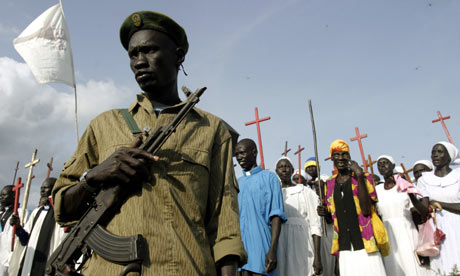
Sudan threatens to wage war against South Sudan

 KHARTOUM: Sudanese President Omar al-Bashir threatened on Wednesday to overthrow the "insect" government of South Sudan, amid global efforts to pull the rivals from the brink of all-out war after the South seized a key oilfield.

"Our main target from today is to liberate South Sudan's citizens from the SPLM ( Sudan People's Liberation Movement), and this is our responsibility before our brothers in South Sudan," Bashir said, adding that the southern government cannot be called a "movement".

"We call it an insect ... trying to destroy Sudan, and our main target from today is to eliminate this insect completely.

He spoke at a youth rally in support of troops who hope to reclaim Sudan's most important oil field, Heglig, from South Sudanese troops who seized it eight days ago.

"There are two choices: Either we end up in Juba or they end up in Khartoum. The old borders cannot take us both," Bashir said, predicting that the victory will be swift.

"In a few hours you are going to listen to good news from your brothers in Heglig," he told about 3,000 young people, some of them dressed in military gear.

"Heglig will not be the end. The end will be in Juba," the South's capital, said Bashir, whose audience sang songs about jihad, or holy war.

While Bashir forecast a swift victory, a foreign ministry official said Sudan is pursuing both military and diplomatic measures to get South Sudan out of the area.

"Military steps are underway ... and they are calculated measures," Omar Dahab, head of the ministry's crisis team, told a news conference.

"At the same time, they are taking into consideration the diplomatic and good offices efforts regarding the ending of the occupation.

"We have to end the occupation by hook or crook, by either way."

Sudan's military has released virtually no information about the situation on the ground but South Sudan has vowed to hold its positions in Heglig, despite air strikes.

Clashes broke out last month in the Heglig area and escalated last week with waves of aerial bombardment hitting the South and Juba's seizure of the oil centre on April 10.

The United Nations, the United States and the European Union have criticised the South's occupation of the north's most important oil field, equally denouncing Sudanese air strikes against the South.

Thursday, April 5, 2012

ASEAN to adopt human rights declaration in November

PHNOM PENH - The Association of South-east Asian Nations (ASEAN) has agreed to adopt a human rights declaration at the conclusion of an annual summit here, as the leaders of the 10-nation bloc formally called on the West to lift sanctions against Myanmar.

Regional leaders said yesterday that they intend to adopt the ASEAN Human Rights Declaration, which is being drafted, when they meet in Cambodia in November.

Philippine diplomat Rosario Manalo said that the declaration will be patterned after the 1948 United Nations declaration. Although non-binding, it is the latest effort by the bloc to promote human rights in a region with a long history of violations, principally in Myanmar.

Yesterday, ASEAN leaders called on Western countries, including the European Union, to lift punitive sanctions imposed on Myanmar now that the once-pariah nation has embraced democratic reforms.

Myanmar was represented by President Thein Sein, who received praise for the recent reforms in his poor nation, most recently Sunday's by-elections won by pro-democracy champion Aung San Suu Kyi and her party.

"We called for the lifting of all sanctions on Myanmar immediately in order to contribute positively to the democratic process and economic development in that country," the heads of state said in a statement, promising to help when Myanmar assumes ASEAN's rotating chairmanship in 2014. AP

Wednesday, March 21, 2012

Rights group cites Syrian opposition for 'serious human rights abuses'


Armed rebels fighting the regime of Syria's Bashar al-Assad have committed "serious human rights abuses," an influential human rights watchdog said Tuesday.
In an open letter to leaders of the opposition, Human Rights Watch cites "increasing evidence" of kidnappings, torture and executions and calls on those forces "to refrain from engaging in these unlawful practices."
The report emerged as the death toll continued to mount in Syria, with dozens of deaths recorded Tuesday by activists. U.N. Security Council members and other world powers worked to address the crisis, which started a year ago when the government began a violent crackdown against protesters.
"We have no time to waste, no time to lose," U.N. Secretary-General Ban Ki-moon told reporters in Indonesia. "The situation has reached unacceptable, intolerable situation now. ... I sincerely hope that the international community will continually speak in one voice and particularly the Security Council, I hope, will be able to be united so they can speak in one voice."
Al-Assad's regime has been denounced across the globe for its apparent slaughter of civilians in an attempt to quash the opposition over the last year.
The United Nations, Syrian activists and groups such as Human Rights Watch have documented widespread violations by Syrian government forces, including the widespread use of torture, arbitrary detentions and indiscriminate shelling of neighborhoods. But abuses by anti-government forces also have been documented during the crisis. 
"The Syrian government's brutal tactics cannot justify abuses by armed opposition groups," said Sarah Leah Whitson, Middle East director at Human Rights Watch. "Opposition leaders should make it clear to their followers that they must not torture, kidnap or execute under any circumstances." 
Human Rights Watch says the protest movement had been "overwhelmingly peaceful" until September, when reports emerged of military defectors and residents taking up arms to defend themselves against government raids and to strike checkpoints and security sites. 
"The intensity of the fighting has increased since early February 2012, when the government began large-scale military attacks against opposition strongholds throughout the country," the group said.
The past year has seen the formation of a resistance group of anti-government military defectors called the Free Syrian Army and a political opposition movement called the Syrian National Council.
Human Rights Watch said many of the anti-government groups reported to be carrying out abuses do not appear to belong to an organized command structure or to be following Syrian National Council orders.
"But Syria's opposition leadership has a responsibility to speak out and condemn such abuses," Human Rights Watch said. "On March 1 the SNC created a military bureau to liaise with, unify, and supervise armed opposition groups, including the Free Syrian Army," the group said.
Human Rights Watch said those kidnapped include security forces, government-supported militia members known as shabiha and their backers. Security force members and civilians also have been tortured and executed, it said.
"Certain armed attacks by opposition groups were motivated by anti-Shia or anti-Alawite sentiments arising from the association of these communities with government policies," Human Rights Watch said. Al-Assad's government is dominated by the minority Alawite community, whose faith is an offshoot of Shiite Islam. About three-quarters of the Syrian population are Sunnis.
Syrian National Council member Sheikh Anas Airout notes "some exceptional situations and unfortunately these are reactions to the horrors, the crimes and the atrocities that the regime keeps committing against our people." But he told CNN that the abuses are "totally unacceptable."
"For a year now, the Syrian opposition didn't resort to any unacceptable act against any pro-Assad civilian or even the soldiers who are killing our people. We encourage our free men to show mercy to our captives because we want to prove to the world that we are better than the Assad regime and we will always be. We do not want to repeat the regime's same mistakes. Saying that, we have to keep it in mind that when we see the killing machine of Assad and his thugs slaughtering our people every hour of the day and the whole world is sitting aside and watching, we know and we understand that there would be some elements who would commit such acts."
Free Syrian Army Lt. Riad Ahmed said a "few incidents are a drop in a bucket in comparison to what the regime is committing."
"The FSA have prisoners and we treat them based on the Geneva Convention. We know that our soldiers and our civilians, men, women and children are being tortured, beaten up and even killed by the Assad thugs," Ahmed said.
The opposition Local Coordination Committees of Syria said at least 52 people were killed across Syria Tuesday.
The Syrian regime launched new assaults on Homs province Tuesday, killing one of the first organizers in the Syrian uprising, an opposition group said.
Heavy shelling in the city of Homs claimed the life of 23-year-old Abdul Rahman Orfalli, the Homs Coordination Committee said. The group said Orfalli helped organize the first protests in the city last March.
He had been arrested twice and tortured during a five-month detainment before returning to Homs to lead demonstrations, the group said.
The LCC reported the discovery in Idlib province of three Free Syrian Army members who had been executed, each shot in the head. The group said the men also "had insults written on their bodies."
It also said the army stormed a field hospital in Idlib and killed three members of the medical staff.
U.N. Security Council members were expected to discuss Syria in closed session on Tuesday. They could support a "presidential statement" supporting the mission of Kofi Annan, the special joint U.N.-Arab League envoy to Syria. U.N. presidential statements aren't legally binding, like resolutions, and require unanimous support.
A five-member U.N. team with expertise in politics, peacekeeping and mediation was in Syria, according to Eduardo del Buey, deputy spokesman for the U.N. secretary-general. The team will stay as long as it is making progress toward goals set by Annan, del Buey said.
The U.N. effort is viewed as an attempt to lure China and Russia -- two countries that have refused to formally condemn the Syrian regime -- to join others in pressuring Syria to cooperate with Annan, who met with al-Assad this month and laid out a series of proposals intended to end the crisis.

Russia and China have said they want an end to the violence but would not place the blame squarely on the regime. Both countries also have major trade ties with Syria.
Ban urged an end to violence by all sides, dialogue for a political solution and unhindered access for humanitarian aid workers.

U.N. officials say the Syrian crisis has killed more than 8,000 people, while opposition activists put the toll at more than 9,000 -- most of them civilians.

Wednesday, February 22, 2012

Christians mark beginning of fasting season today

Christians in Pakistan and around the world will observe the beginning of the Lenten season with Ash Wednesday today.

Ash Wednesday is observed as a sign of repentance of the whole community. The ashes are placed on the forehead by the priest with the Sign of the Cross and the words: Remember you are dust, and into dust you shall return.

“Those ashes are last year’s palms from Palm Sunday. They are burnt and ashes are made from them and then blessed,” he said. During Lent Christians are encouraged to fast, pray, give alms and seek repentance for their sins for forty days in order to prepare for Easter.

“The time of Lent is important for us because it gives time to us to change and become closer to God, the priest said. In his message for Lent 2012 on the Vatican website, Pope Benedict XVI states that “in a world which demands of Christians a renewed witness of love and fidelity to the Lord, may all of us feel the urgent need to anticipate one another in charity, service and good works.” Masses will be held in churches across the city at different timings to observe the day.